Cybersecurity Consulting Firm – Cyber Castellum

The State of K-12 Cybersecurity
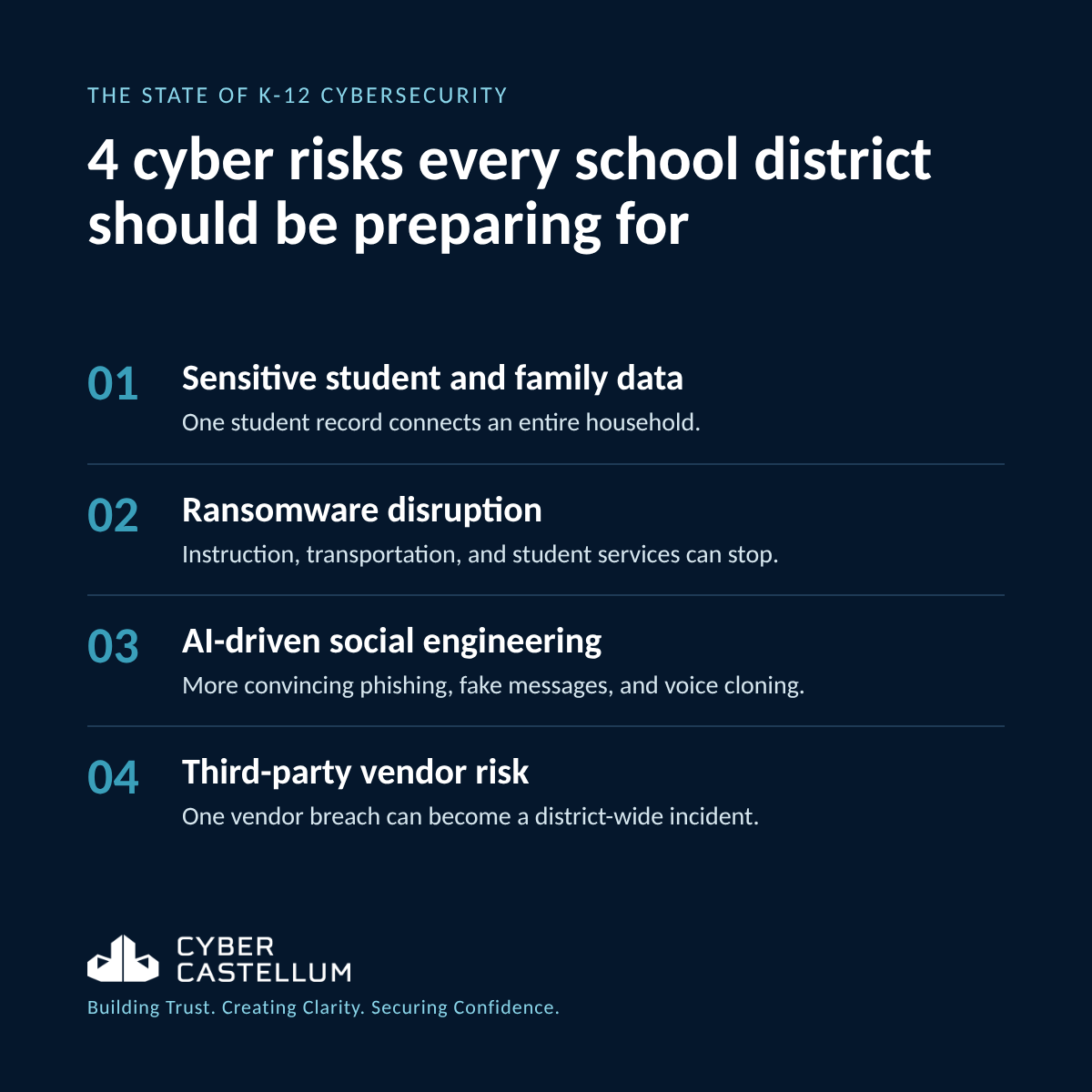
Four cyber risks every school district should be preparing for
School districts hold some of the most sensitive data in their communities. Enrollment files, health records, individualized education programs, bus routes, and emergency contacts all sit inside systems that were built to serve students, not to withstand a determined attacker.
For years, protecting that information was treated as an IT task. That framing no longer fits. A district connects students, families, caregivers, educators, and support networks, so when something goes wrong, the effects travel well past the server room and well past the classroom.
This post looks at why student data deserves a wider lens, the four risks we think every district should be planning for, and a few practical places to start.
One student record, an entire household
A student record is rarely about one person. Follow the fields in a typical file and you find a parent’s employer and financial details, a guardian’s identity and home address, a grandparent listed as an emergency contact, a pediatrician’s office, and siblings enrolled in other schools.
That is why we say protecting student data means protecting entire households. When a single record is exposed, the people connected to it are exposed too: parents and guardians, other relatives and close contacts, healthcare providers, and in some cases employers and other schools.
Seen this way, cybersecurity in K-12 is a question of community safety, trust, and resilience. It belongs on the agenda of the superintendent and the school board as much as the technology director.
1. Sensitive student and family data
Student records often combine medical, behavioral, and special education information with parent, guardian, and emergency contact data. Few other organizations hold that mix about people so young.
The time horizon is what makes it different. A child has no credit history to monitor and no reason to check one, so identity theft can go unnoticed for years. It often surfaces only when the student applies for a first loan, apartment, or job. A compromised record can carry privacy, identity, reputational, and professional consequences long after graduation.
Questions worth asking: Do we know every system where student and family data lives? Who can access it, and is that access still needed? How long do we keep records for students who have left the district?
2. Ransomware disruption
Ransomware is usually discussed in terms of data, but for a district the first impact is operational. An attack can interrupt instruction, transportation, communications, and access to the services students depend on, from meal programs to counseling.
The useful question is not whether a district faces cyber threats. It does. The useful question is whether the district is prepared to respond: who makes decisions, how families are informed, how long critical systems can be down, and whether backups have been restored in a test rather than only assumed to work.
Preparation has a cost in staff time and attention, and no plan removes the risk. What a rehearsed plan does is shorten the disruption and reduce the number of decisions made under pressure.
Questions worth asking: When did we last restore from backup as a test? Could we run a school day without our student information system? Does leadership know its role in the first 24 hours?
3. AI-driven social engineering
Artificial intelligence is making phishing emails, fraudulent messages, and voice-cloning attacks more convincing than they used to be. The old advice to look for spelling mistakes and awkward phrasing is losing its value.
Schools are an attractive setting for this. Staff directories, board minutes, and event calendars are public by design, which gives an attacker the names, roles, and timing needed to personalize a message. A payroll change request that appears to come from a principal, or a call to a parent that sounds like the front office, is harder to dismiss when the details are right.
Employees, administrators, and families are all being targeted, so awareness cannot stop at the staff room. Technical controls such as multi-factor authentication matter, and so do simple procedures: verify payment and account changes through a second channel, every time.
Questions worth asking: Does our training reflect current tactics, including voice and text? Is there a verification step for financial and account requests that does not rely on email alone? Do families know how the district will and will not contact them?
4. Third-party vendor risk
A modern district runs on outside technology: student information systems, learning platforms, assessment tools, transportation and food service software, communication apps. Many of these providers hold or can reach sensitive data.
That reliance is reasonable. Few districts could build or secure these tools themselves. The tradeoff is that the district’s exposure now includes every vendor’s security practices, and a single vendor breach can quickly become a district-wide incident. Families will look to the district for answers, whoever was at fault.
Questions worth asking: Do we have a current inventory of vendors and the data each one holds? Do our contracts set security expectations and breach notification timelines? When a tool is retired, is the data returned or deleted?
Where to start
None of these risks calls for a large program on day one. Most districts make meaningful progress with a short list of steps, taken in order:
- Map the data. Identify where student and family information is stored, who can access it, and which vendors receive it.
- Assess honestly. A security assessment and regular vulnerability scanning show where the gaps are, so limited budget goes to the issues that matter most.
- Write the response plan, then practice it. A tabletop exercise with district leadership, not only IT, surfaces the decisions that are hardest to make mid-incident.
- Review vendor agreements. Start with the providers that hold the most sensitive records.
- Make it a governance topic. Regular reporting to the superintendent and board keeps cybersecurity tied to student safety and continuity of operations.
Each step is useful by itself, and each makes the next one easier.
Cyber Castellum – K12 one-pager
How Cyber Castellum can help
Cyber Castellum partners with K-12 school districts to strengthen cybersecurity through governance, risk management, security assessments, vulnerability management, incident response planning, and strategic advisory services.
If you would like a second opinion on where your district stands, we are glad to talk it through. Contact – Cybersecurity Consulting Firm – Cyber Castellum, call +1 (888) 884-4511, or email info@cybercastellum.com.